
What Is Schizophrenia?
Let’s Establish a Baseline for Understanding the Illness

I’m almost ashamed of myself.
I write weekly about my disease of schizoaffective disorder, but I’m not sure I have ever established a basic understanding of the illness with my readers.
I just assume all of you know the details.
I often use the terms schizophrenia and schizoaffective disorder interchangeably. They are distinct diseases, but a more encompassing term is schizo-spectrum disorder.
According to Gemini: “Schizophrenia is a chronic, severe brain disorder that causes people to interpret reality abnormally, often involving hallucinations, delusions, and disorganized thinking.”
Also according to Gemini: “Schizoaffective disorder is a chronic mental health condition combining schizophrenia symptoms with a major mood disorder, such as bipolar disorder (mania) or depression.”
I think, based on those definitions, I may be excused for sometimes using them interchangeably.
I’ll share that sometimes I use the term schizophrenia simply because it is, in my opinion, the more widely understood of the two. People get a picture in their mind when they hear that word.
In reality, I have always thought that schizoaffective disorder is a more severe condition. You experience delusions and hallucinations, but on the amped-up scale of manic living.
In spite of the ramifications for daily life, I have read that people with schizoaffective disorder often have better treatment outcomes. They seem to accept and receive treatment better. This is backed up by research from psychiatryonline.org.
In terms of my own experience, I have had both diagnoses applied to me.
My timeline for developing the disease was fairly standard. Research indicates that for most men, the disease develops between the ages of 16 and 30. For me, the delusions and paranoia were becoming manifest at approximately age 25.
But there is a twist to my inception of the disease.
I was hospitalized with bipolar disorder when I was 21. I was prescribed the same medication at 21 that I take today with my schizoaffective diagnosis. Granted, I’m on significantly more medication now, but it is the same drug.
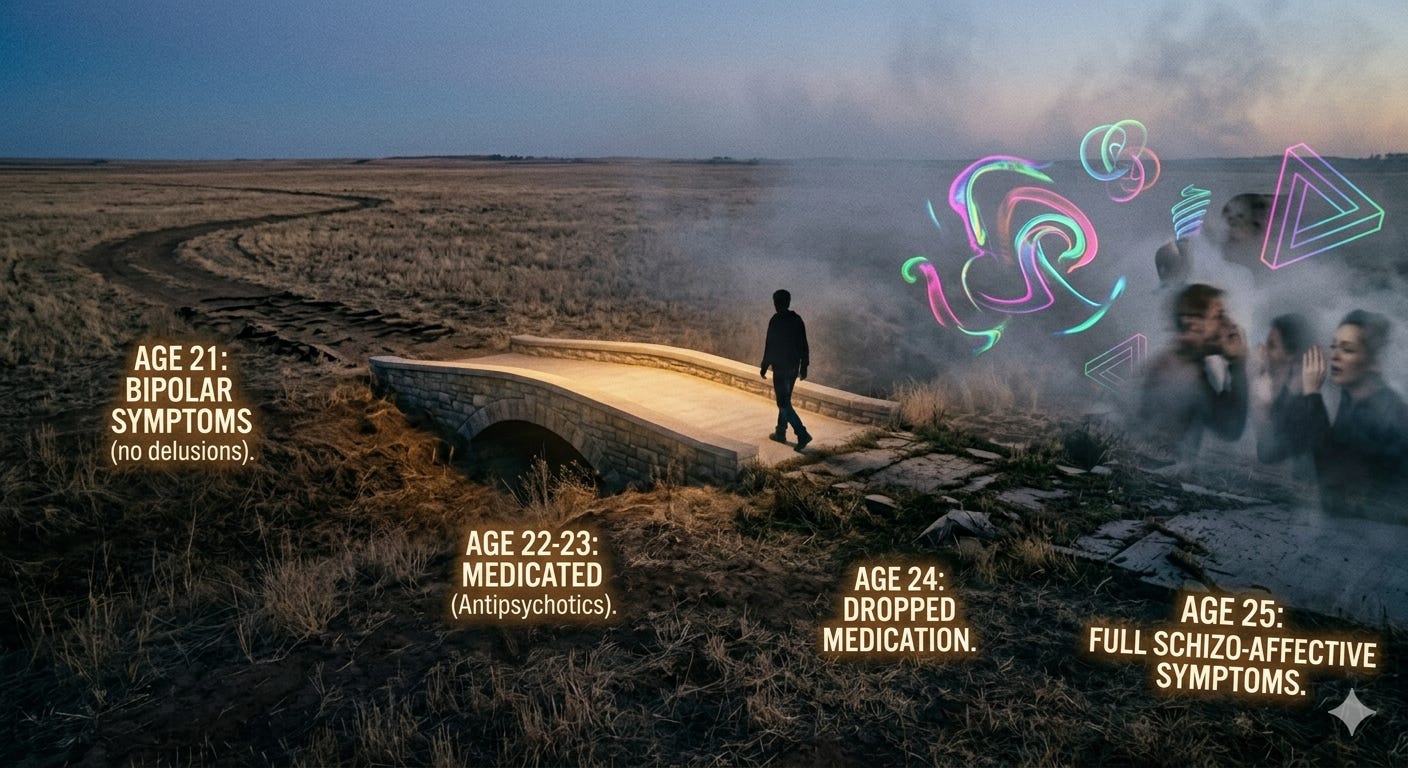
My point is that I may have seen the full schizo-spectrum symptoms earlier had it not been for this medicated period. Perhaps a list can communicate it best:
Age 21 – Experienced bipolar symptoms; was not yet delusional or paranoid.
Age 22–23 – Medicated with an antipsychotic.
Age 24 – Dropped all medication.
Age 25 – Began to experience the full symptoms of schizoaffective disorder.
I suppose it is important to me to lay out this timeframe. It supports the idea that I really did have a classic inception of the disease.
I have wondered in the past about the fact that it was “purely” bipolar in my early days. Today, I can say that had it not been for the antipsychotic at age 22, I likely would have developed those full delusions and hallucinations sooner.
You have suffered through my musings and ruminations on this difficult illness.
The only message and point I have today is this: EARLY TREATMENT HELPS! With every relapse of symptoms, I have required more medication. My life would be a lark if I were still on that low dosage I had at age 22—assuming it could still control my symptoms.
My latest book is: “Schizophrenia and Keto: Taming Myself One Meal at a Time” - Mathew Poehler
I would love to have you read it and leave a positive review. I am running a price promo where you can get it at cost. It is a quick read.

***
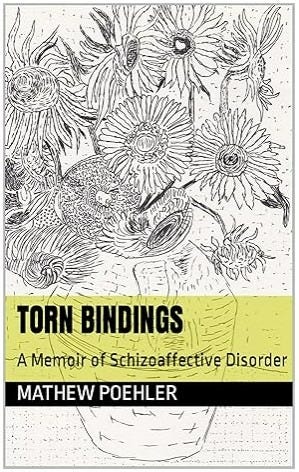
As an extra note, I have documented my life with schizo-spectrum disorders in my memoir - “Torn Bindings” by Mathew Poehler - found on Amazon here - I would love to have a positive review.
Thank you for sharing your story! It helps those that have this illness and provides insight and comfort to family members that see their loved ones suffering and feel helpless for what to say-what to do-definitely most needed!
Thanks for clarifying these two conditions. For many people, symptoms are confusing and don't necessarily follow a continuum. Your description of your experience is helpful.